
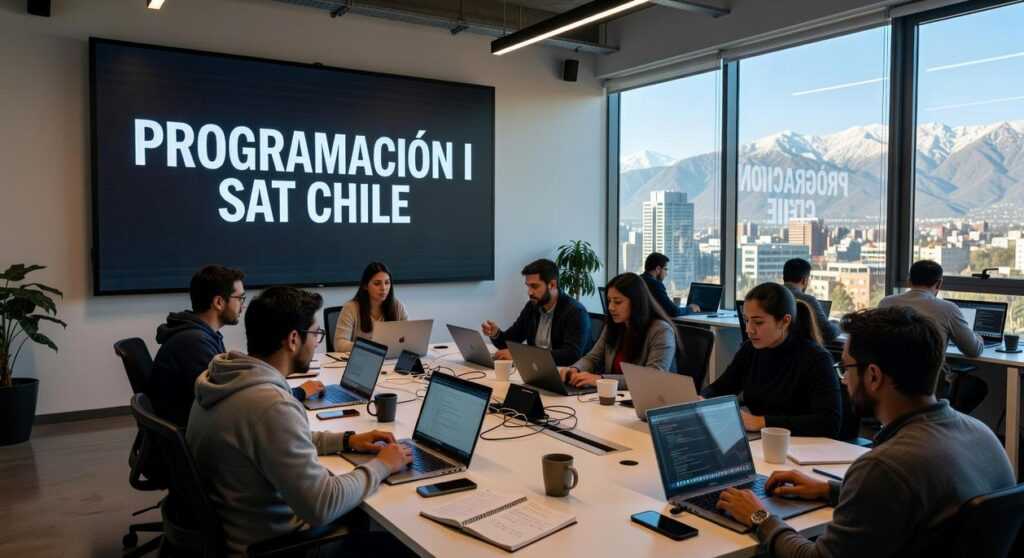
I love diving into the world of beauty and style. It’s all about finding what works for you and owning it. Whether you’re into bold makeup or a minimalist look, there’s something out there for everyone. Let’s explore some fresh ideas and trends that can help you stand out.
programación i sat chile is a bit off-topic, but if you’re curious, we can chat about that too. For now, let’s focus on making you feel fabulous.
Your Complete Guide to SAT Chile’s Programming I Course
You’re here because you want the real deal on the SAT Chile Programming I course. I get it. Sifting through vague and scattered information can be frustrating. My goal with this guide is to give you a clear, one-stop resource. We’ll cover the official syllabus, required study materials, and what you can expect to learn.
This course is perfect for beginners. If you have little to no coding experience, this is your starting point. It’s designed to help you build a solid foundation in programming. By the end, you’ll have a good grasp of the basics and be ready to tackle more advanced topics.
When I first started, I made some mistakes. For example, I didn’t set aside enough time for practice. Theory is great, but you need to code to really understand it. (Pro tip: Make sure to schedule regular coding sessions.)
Another error was not asking for help when I needed it. I thought I could figure everything out on my own. But that just led to confusion and wasted time. Don’t be afraid to reach out to your instructors or classmates if you’re stuck.
By sharing these lessons, I hope to help you avoid the same pitfalls. With the right preparation and mindset, you can make the most of programación i sat chile and set yourself up for success.
Course Fundamentals: What You’ll Learn and How
The core objective of this course is to build a strong foundation in algorithmic thinking and logical problem-solving. These skills are the building blocks of all programming.
Our learning methodology combines theoretical lectures, hands-on laboratory sessions, and practical project work. This mix ensures you get both the knowledge and the practice you need.
By the end of the course, you’ll be able to design algorithms, write pseudocode, and implement solutions to basic computational problems. No prior programming knowledge is required, but basic computer literacy—like file management and internet use—is essential.
If you’re curious about how these skills can apply in real-world scenarios, check out wylette leak. It’s a great example of how logical problem-solving can be used creatively.
In the next section, we’ll dive into the specifics of each module. For now, just know that programación i sat chile is a term you might come across, and we’ll break it down for you.
Deconstructing the Syllabus: Core Concepts and Logic
Let’s dive into the first half of the course syllabus. I’ll break it down module by module, giving you my take on what’s essential.
Module 1: Introduction to Algorithms and Problem Solving
This is where it all starts. Pseudocode and flowcharts are your new best friends. They help you map out your thoughts and make sure your logic is sound. The concept of a variable? It’s like a container for data. You’ll use it to store and manipulate information. Simple, right?
Module 2: Fundamental Data Types and Expressions
Here, we get into the nitty-gritty. Integers, real numbers, characters, booleans—these are the building blocks. Arithmetic and logical operators let you do the math and make decisions. It’s like having a toolbox, and each tool has a specific job. Get comfortable with these, and you’ll be set up for success.
Module 3: Sequential and Conditional Control Flow
Now, things get a bit more interesting. ‘If-then-else’ statements and nested conditionals are how you make your code smart. These structures help your program decide what to do based on certain conditions. It’s like setting up a series of if-then scenarios in your head. If this happens, then do that; otherwise, do something else. It’s a powerful way to control the flow of your program.
Module 4: Iterative Structures and Loops
Loops are your go-to for handling repetitive tasks. ‘For’, ‘while’, and ‘do-while’ loops are the stars here. They save you from writing the same code over and over. Imagine you need to count from 1 to 100. A loop does that for you in a few lines. Efficient, right?
I’ve seen a lot of students get stuck on loops, but once you get the hang of them, they’re a game-changer. Just remember, practice makes perfect. And don’t forget, programación i sat chile can be a great resource for diving deeper into these concepts.
Building Complexity: Advanced Syllabus Topics

As we move into the latter half of the course, we dive deeper into more advanced concepts. Let’s break it down.
Module 5: Working with Structured Data – Arrays
One-dimensional arrays (vectors) and two-dimensional arrays (matrices) are essential for organizing data. Have you ever wondered why these structures are so crucial? They help us manage and manipulate large sets of data efficiently. Whether you’re dealing with a list of numbers or a grid of information, arrays have got you covered.
Module 6: Modular Programming with Functions and Procedures
Breaking down problems into smaller, reusable subroutines or functions is key. Modular programming makes your code cleaner and easier to maintain. Imagine building a complex program without this approach. It would be a mess, right? By using functions, you can tackle each part of the problem one step at a time.
Module 7: Basic File I/O Operations
Reading data from and writing data to external text files is a fundamental skill. Data persistence is vital in any application. You need to store and retrieve data reliably. This module will teach you how to handle file operations, making sure your data stays safe and accessible.
Pro Tip: Always test your file I/O operations with small, manageable datasets first. This way, you can catch and fix any issues before scaling up.
Questions to Ponder:
- How do arrays make data management more efficient?
- Why is modular programming important for maintaining large codebases?
Remember, mastering these skills will give you a solid foundation in programación i sat chile.
Essential Tools and Materials for Success
When it comes to getting the most out of your programming course, having the right tools and materials is key. Here’s what you need:
Software:
- Integrated Development Environment (IDE) or Code Editor: For this course, I recommend using PSeInt or Dev-C++. These are user-friendly and perfect for beginners.
- Compiler/Interpreter: Make sure you have a good compiler or interpreter installed. This will help you run and test your code.
Official Course Documentation:
- When you enroll in programación i sat chile, you’ll get access to official course packets, lab manuals, and digital textbooks. These are your go-to resources for assignments and detailed instructions.
Recommended Supplementary Resources:
- Coding Practice Websites: Sites like HackerRank and Codecademy offer plenty of coding challenges and tutorials. They’re great for extra practice and mastering new concepts.
- YouTube Channels: If you learn better by watching, check out some popular coding channels on YouTube. Look for ones that focus on step-by-step tutorials and real-world examples.
Hardware Requirements:
- To run the required software smoothly, you’ll need a computer with at least 4GB of RAM and a modern processor. Most laptops and desktops from the last few years should work just fine.
With these tools, you’ll be well-equipped to tackle your programming journey. Happy coding!
Is Programming I Your Next Step in Tech?
In Programming I, you’ll gain key skills like algorithmic thinking, logical structuring, and foundational coding practices. These skills are essential for more advanced studies, such as Programming II, Data Structures, or Object-Oriented Programming.
Why is this course so important? According to a recent study by the National Bureau of Economic Research, students who complete introductory programming courses are 30% more likely to succeed in advanced tech fields. This foundation is crucial for any future career in software development, data analysis, or IT.
Real-world applications are vast. For example, algorithmic thinking helps in optimizing code, making apps run faster and more efficiently. Logical structuring is vital for building robust and maintainable software systems. These skills are not just theoretical; they directly impact your ability to solve complex problems in the tech industry.
If you’re ready to take the next step, visit the para imprimir cinnamoroll de papel official site for the latest enrollment dates, application procedures, and contact information for academic advisors. Enroll in programación i sat chile and start building the skills that will set you up for success.
programación i sat chile
Para aquellos interesados en la programación i sat chile, es importante estar atentos a las últimas actualizaciones y novedades. La programación de canales por satélite en Chile puede variar según el proveedor, pero generalmente incluye una amplia gama de opciones, desde noticias y deportes hasta entretenimiento y series internacionales.
Es recomendable consultar el sitio web oficial del proveedor de servicios de televisión satelital o su aplicación para obtener la información más reciente y precisa. Además, algunos proveedores ofrecen funciones adicionales, como grabación de programas y acceso a contenido bajo demanda, lo que puede mejorar significativamente la experiencia del usuario.