
Move beyond a face-shape label and arrive with clear preferences, realistic upkeep limits, and reference images your stylist can discuss.
Contributed by GlowUpFace
A saved haircut photo can show the result you like without explaining why you like it. Is it the fringe, the movement near the cheeks, the clean outline at the neck, or simply the polished styling? Until those details are separated, “something like this” leaves plenty of room for different interpretations.
The most useful preparation is a short salon brief: a description of your hair, the elements you want to explore, and the upkeep you will realistically do. Reference photographs and AI previews can support that conversation. Neither replaces the professional assessment of the hair that will actually be cut.
Start with the hair you live with
Describe how your hair behaves on a normal day, not only immediately after a professional blow-dry. Does it settle straight, form waves, or curl? Where does it tend to separate? Which sections are difficult to position? Tell the stylist about your usual part, current length, and any styling habits you rely on.
It helps to distinguish the terms used in the conversation. Fine or coarse describes strand thickness; density concerns how much hair occupies an area; straight, wavy, curly, or coily describes pattern. You do not need to assign exact categories yourself. Ask the stylist to explain which characteristics matter for the reference you brought.
The American Academy of Dermatology’s healthy-hair guidance starts with understanding hair type and choosing care accordingly. That is a useful reminder to make the proposed cut work with your real hair and routine. A picture of a different person cannot provide that assessment for you.
Use face shape as vocabulary, not a verdict
A face-shape label can help describe proportions, but it does not tell you which haircut you must choose. Instead of asking which style “fixes” your face, describe the visual effect you enjoy: more openness around the forehead, a softer outline near the cheeks, a compact silhouette, or more movement through the ends.
Try completing two sentences: “I like the way this part of the haircut looks,” and “I would not want this part for myself.” For example, you might enjoy the movement in a layered cut but dislike how much hair falls across the eyes. That distinction is useful even without agreeing on whether your face is oval, round, or something in between.
Treat style as a preference rather than a correction. There is no need to chase a supposedly ideal outline or use a numerical appearance score to justify a choice. The brief should make room for what you like wearing, including styles that do not follow a generic face-shape chart.
Choose fewer references and explain each one
Bring two or three useful images rather than a large folder of unrelated looks. Add a short note beside each: “the length at the front,” “the softer edge around the ears,” or “the amount of volume, but not the color.” A reference becomes easier to discuss when the requested feature is explicit.
Include a clear, recent picture of your own usual hair if the appointment-day styling is unusual. Where possible, look at front, side, and back views of the proposed cut. Do not assume that one carefully selected angle explains the whole shape. Ask which parts are created by cutting and which depend on styling, extensions, or other services.
Use an AI preview to narrow the conversation
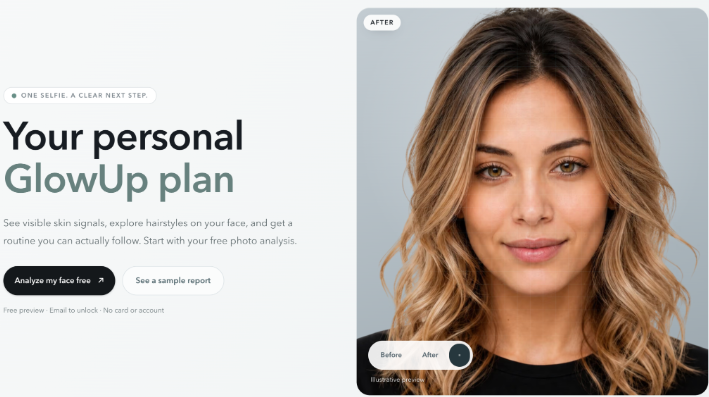
Seeing an option on your own portrait can make a preference easier to describe. GlowUpFace’s hairstyle finder presents a six-panel comparison in its paid full report: the current hairstyle as a reference alongside five generated alternatives, with an AI-highlighted option. The images are illustrations to discuss, not guaranteed salon outcomes or proof that one cut is objectively best.
Compare the outline, fringe placement, and framing that interest you. Do not assume the generated image accurately reproduces your density, growth pattern, or styling behavior. Ask the stylist what can be achieved with your current hair, which details would need adaptation, and what the cut would look like without the finishing shown in the preview.
Keep the original portrait available next to the generated versions. It gives both of you a clear starting point. Before uploading, read the service’s photo-handling terms and decide whether you are comfortable with them; a useful styling exercise does not require sharing more personal data than you intend.
Set an honest maintenance budget
Upkeep includes minutes, appointments, products, and technique—not only the price of the initial haircut. Tell the stylist how often you usually wash and style your hair, whether you prefer air-drying, and how much time you will spend on an ordinary morning. A simple, repeatable routine may suit you better than a look you only enjoy on appointment day.
Ask how the cut grows out, when it is likely to need reshaping, and whether a fringe would require extra attention. Get the salon’s own estimate instead of relying on a universal maintenance schedule. “Low maintenance” means different things to someone who already blow-dries daily and someone who avoids heat tools.
The American Academy of Dermatology’s hair-damage guidance advises reducing heat exposure and avoiding styles that pull tightly. That does not prescribe a particular haircut. It gives you a reason to ask whether the everyday version of a style can be comfortable and achievable without repeated high heat or tension.
Bring a brief the stylist can respond to
Here is an illustrative brief, not a client testimonial: “I would like more movement around my face while keeping enough length to tie back. I usually air-dry and prefer a short morning routine. In the first picture, I like the front shape; in the second, I like the overall length. Please show me where the shortest section would fall and explain what would need styling at home.”
For a shorter cut, the same structure works: identify the outline you want, the length you want to preserve, and the parts you find difficult to style. Ask the barber or stylist to confirm the plan before starting. The goal is shared understanding, not arriving with a technical instruction that overrides professional judgment.
Leave with a plan for the next morning
Before the appointment ends, ask for a demonstration of the simplest way to wear the cut and write down the few steps you expect to use. Clarify what requires a salon visit and what you can maintain yourself. Judge the haircut by how it works in your life, not by whether it exactly reproduces a polished or generated image.
A good preview helps you identify a direction. A good consultation makes that direction practical. Arriving with both a visual preference and a realistic routine gives the stylist something far more useful than a request to copy another person’s hair.